
Dark Matter Origins: Tiny Black Holes & Cosmic-Horizon Hawking Radiation

Why dark matter still puzzles us
Dark matter seems to make up ~27% of the cosmos, dwarfing the ~5% of ordinary matter. We infer it from gravitational clues—galaxy rotation curves, gravitational lensing, cosmic structure growth—but we still don’t know its composition. Classic candidates like WIMPs (weakly interacting massive particles) have evaded detection so far, motivating radically different directions.
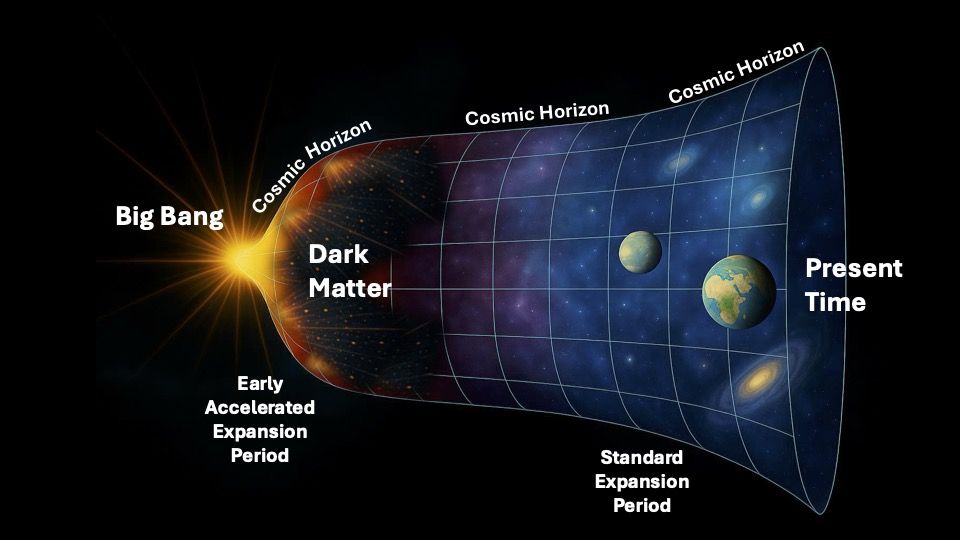
Two such directions getting buzz: (1) a dark sector with its own forces forming heavy composites (“dark baryons”) that can gravitationally collapse into tiny black holes, and (2) Hawking-like radiation from early-universe cosmic horizons birthing dark particles during a brief expansionary phase after inflation.
Model A: Dark baryons collapsing into mini black holes
Think of a hidden copycat world: not identical to ours, but with its own strong-like force confining dark “quarks” into dark baryons. If those composites become sufficiently massive and compact, they could collapse into tiny black holes. If Hawking evaporation is suppressed in this regime, such black holes would be effectively stable—and a natural match for dark matter’s “invisible but gravitational” behavior.
Why a dark sector isn’t that weird
Even in the Standard Model, particles respond differently to forces: quarks feel the strong force; electrons don’t. By analogy, an unseen sector could carry forces our instruments barely (or never) detect. In that sector, heavier composites are quite plausible.
How does collapse happen?
Once a bound state surpasses a critical mass/compactness, gravity dominates. The system passes its own Schwarzschild limit and forms a black hole with horizon radius rs. If many such collapses occurred in the early universe, a cosmic population of mini black holes would emerge—behaving collectively like dark matter.
Model B: Hawking-like radiation at hot cosmic horizons
The observable universe has a cosmic horizon: regions receding so fast their light will never reach us. In the very early universe, a short second burst of accelerated expansion (a “mini-inflation”) could create hot horizons. Quantum effects at such boundaries are analogous to black hole horizons—potentially generating radiation. If some of that energy materialized as stable particles, you have a purely gravitational mechanism to populate the universe with dark matter.
Why this is intriguing
It ties dark matter genesis to spacetime geometry and early expansion history, not to speculative interaction cross-sections with ordinary matter. In principle, this can produce a spectrum of particle masses, depending on horizon temperature and expansion details.
Key equations & quick math
Sets the size of a black hole’s event horizon for mass M. If a dark-baryon bound state becomes compact enough that its radius < rs, it collapses.
Tiny black holes are hotter (smaller M → higher TH). Model A needs mechanisms that suppress evaporation so those mini BHs survive cosmological timescales.
Classically, very small black holes evaporate quickly; suppression or new physics is required for longevity.
Even tiny compact objects can, in principle, reveal themselves via microlensing if alignment and distances (D) cooperate.
Cosmology constrains how much total matter exists; any dark-matter model must reproduce Ωm without wrecking structure growth or CMB observables.
Milestone timeline: from hints to bold theories
How could we test these ideas?
1) Gravitational microlensing
If part of dark matter is compact (mini BHs), precise time-domain surveys can catch tiny lensing blips. It’s challenging (small masses → faint, fast signals) but not impossible with next-gen cadence and sensitivity.
2) Structure formation & small-scale power
Dark matter granularity, free-streaming, or self-interactions subtly alter halo abundance and internal profiles. Comparing simulations to lensing maps and dwarf-galaxy counts can prune parameter space.
3) Early-universe imprints
Horizon-production scenarios may leave traces in primordial spectra or non-Gaussian features. Future CMB polarization and 21-cm surveys could help.
4) High-energy signatures
If any evaporation or conversion channels exist, ultra–high-energy photons or neutrinos could appear. Observatories (Fermi, CTA, IceCube, LHAASO) provide constraints.
FAQs
Is a dark sector really necessary?
Not strictly—there are other candidates (axions, sterile neutrinos). But dark-sector dynamics naturally allow heavy composites that could collapse into tiny black holes.
Wouldn’t tiny black holes evaporate fast?
Ordinarily yes. The proposal invokes conditions that suppress Hawking radiation, letting mini BHs survive cosmological times.
What’s special about cosmic horizons?
Like black hole horizons, they separate regions forever out of contact. Quantum effects at hot horizons in the early universe could create particles—potentially dark matter.
Could both ideas be partly true?
Possibly. The dark sector might produce a mix: some mini BHs plus particle dark matter from horizon effects. Observations will determine the blend.
Will this break my site’s theme?
No. Styles are scoped, minimal, and avoid global resets. You can paste this into any post/page safely.
Bibliographic quotes
“If particles won’t reveal themselves, maybe gravity already has.” — S. Profumo (2025), interview context: dark matter beyond WIMPs
“Flat rotation curves tell us something massive is missing.” — V. Rubin (paraphrased principle), on galaxy dynamics
“Black holes radiate because horizons disturb the quantum vacuum.” — S. Hawking (concept summary), on Hawking radiation
“Lensing separates where light is from where mass is.” — Gravitational lensing principle used in cluster studies (e.g., Abell 520)
Selected references (for readers)
- Abell 520 composite image credit: NASA / ESA / CFHT / CXO / M.J. Jee & A. Mahdavi.
- Early-universe horizon & dark matter production: horizon radiation concepts & inflation-era dynamics (overview articles).
- Galaxy rotation & dark halos: Rubin & Ford rotation-curve studies.
- Gravitational lensing primers: cluster mergers and mass mapping.
Note: Quotes above are short thematic summaries or paraphrases to keep within fair-use and readability.
